
The short version
- Most “agent” projects are really fixed workflows with a few judgment steps.
- Map the process first. Use plain code for fixed steps, a model for judgment steps, and an agent only when the path cannot be known in advance.
- Move up one level of autonomy at a time, and only with evidence.
The problem
Every AI roadmap I review this year has the word “agent” on it. Most of the problems underneath are workflows with one or two judgment calls in them.
That distinction matters more than any model choice. A workflow is a path you can draw in advance, with a model making a decision at specific steps. An agent decides the path itself. The first is software with intelligence inside it. The second is a system that plans, and planning is where cost, variance and risk multiply.
A workflow follows steps you set in advance. An agent decides its own steps. Agents can do more, and they cost more and are harder to control.
Map the process first
The first engineering act in any AI program should be process mapping, not prompting. Walk the real workflow with the people who run it, including the exceptions nobody wrote down. Then mark every step with one of three labels.
- Deterministic. The rule is known and stable. Use code, an API call or a lookup. A model here adds cost and variance and nothing else.
- Probabilistic. The step needs judgment over messy input: classifying an email, extracting fields from a drawing, drafting a reply. A model belongs here, inside a step you control.
- Adaptive. The path itself cannot be known in advance. The system must choose tools, order and depth based on what it finds. This is the only place an agent earns its keep.
In most commercial workflows I have mapped, the large majority of steps are deterministic, a handful are probabilistic, and very few are truly adaptive. Design for that ratio.
Most steps in a business process follow fixed rules. A few need judgment. Very few need the system to work out its own path.
The autonomy ladder
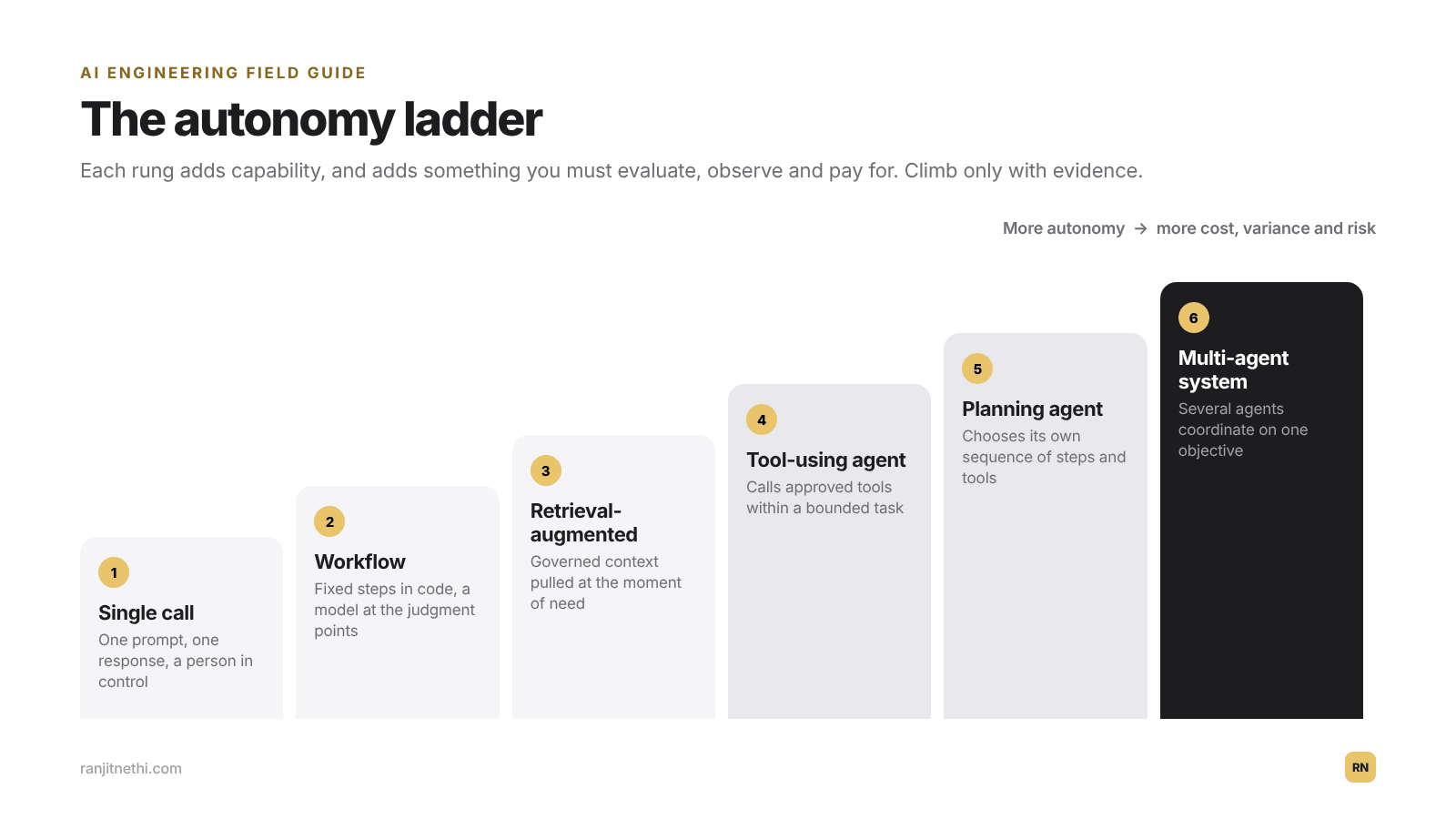
I think about AI system patterns as a ladder. Each rung adds capability and adds something you must now evaluate, observe and pay for.
- Single call. One prompt, one response, a person in control. Drafting, summarizing, classifying.
- Workflow. A fixed sequence of steps in code, with a model at the judgment points.
- Retrieval-augmented workflow. The same, with governed context pulled from your data at the moment of need.
- Tool-using agent. The model may call approved tools, within a bounded task.
- Planning agent. The model decides the sequence of steps and tools to reach a goal.
- Multi-agent system. Several agents with distinct roles coordinate on a larger objective.
The rule is simple. Climb only when the rung below cannot do the job, and only with evidence that it cannot.
Start with the simplest design that works. Add freedom only when you can show the simpler design is not enough.
Four questions before you add autonomy
Before approving a move up the ladder, I ask four questions.
Is the path knowable in advance? If an expert can draw it on a whiteboard, build the workflow. Planning autonomy is for problems where the next step genuinely depends on what the last step discovered.
What does a wrong action cost? A wrong draft costs a minute of review. A wrong price, order release or customer commitment costs money and trust. The higher the cost of error, the lower the rung, or the stronger the human checkpoint.
Can you observe every step? If you cannot trace why the system did what it did, you cannot debug it, defend it or improve it. Autonomy without traces is a liability you have not discovered yet.
Will it run often enough to evaluate? Evaluation needs volume. A process that runs ten times a month cannot produce the evidence an autonomous system requires. High-volume, repetitive work is where autonomy pays back the investment in testing.
What “good” means at each level
In traditional software, good means correct. The same input produces the same output, and a test either passes or fails.
In AI systems, good means reliably useful within a tolerance. You are not striving for 100% on every output, because that is not always possible. You are asking whether the system makes people meaningfully more effective, with errors caught before they matter.
In agentic systems, good adds a third dimension: the path. An agent can reach a correct answer through a wasteful or risky route. So you evaluate the outcome, the steps taken and the cost of getting there.
For normal software, good means correct every time. For AI, good means useful and safe most of the time, with mistakes caught before they matter.
Leaders who carry a software definition of quality into an agentic program will either ship nothing or ship something they cannot control.
The design that works most often
The design I see succeed most in enterprises is unglamorous. Deterministic software carries most of the flow. A model handles intake and judgment at a few points. Retrieval supplies governed context. A human approves anything consequential. Autonomy expands one action class at a time as the evaluation data earns it.
That system will rarely make a keynote. It will make it to production.
The rule
Earn autonomy one rung at a time. If you cannot name the evidence that justified the last rung, you are not ready for the next one.
Which of your agent projects is really a workflow with a good model inside it?
The terms, in plain language
| Term | What it means |
|---|---|
| Workflow | A fixed series of steps set in advance |
| Agent | An AI system that chooses its own steps to reach a goal |
| Deterministic | Follows fixed rules and gives the same result every time |
| Probabilistic | Uses judgment, so results can vary |
| Tool | A system or function the AI is allowed to call, such as a price lookup |
| Trace | A full record of what the system did, step by step |
Shorter articles and updates filed under this section, newest first.
Section 6.1 of the AI Engineering Guide · Last reviewed November 2026