
The short version
- When an AI assistant gives a wrong answer, the cause is usually missing information, not a weak model.
- The step that finds information is called retrieval. It needs an owner and its own quality test.
- Before any launch, ask one question: what does the assistant do when it cannot find the answer?
The real problem
When an AI assistant gives a confident wrong answer, most people blame the model. In my experience the model is rarely the problem. The answer was wrong because the right information never reached it.
This kind of failure is quiet. A table gets cut in half. A filter leaves out the latest version of a document. A scanned file was never read. The model gets part of the picture and writes a fluent answer from it.
The technical name for the fix is to treat retrieval as a data product. That means it has an owner, a written quality standard and its own tests.
Think of the model as a smart new employee and retrieval as the filing clerk who hands them documents. If the clerk hands over the wrong file, the employee gives a wrong answer with full confidence. Most failures are the clerk’s, so manage the clerk.
How an assistant finds information
Engineers call this design retrieval-augmented generation, or RAG. It has two halves.
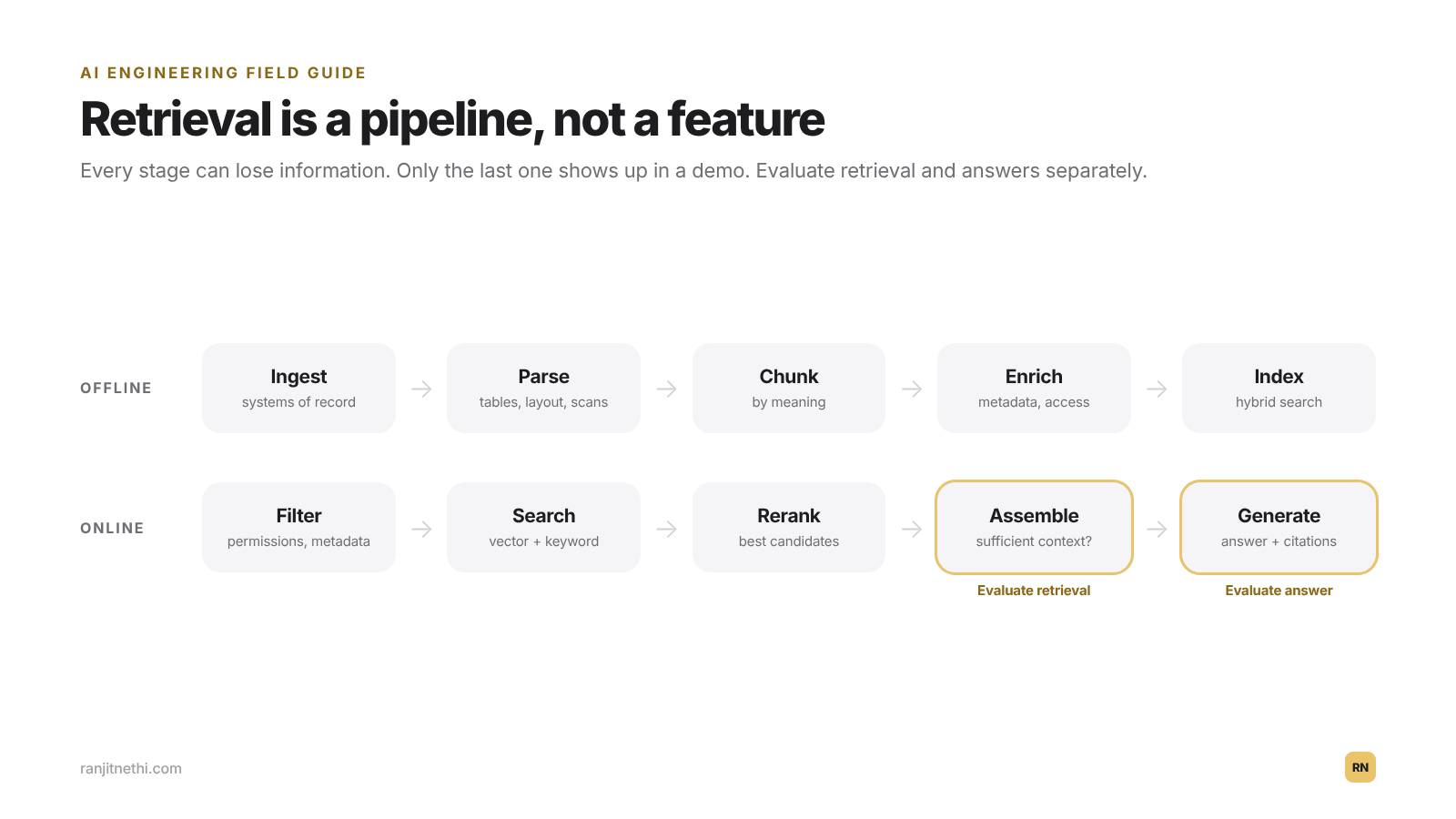
Offline, before anyone asks a question. The system ingests documents from source systems, parses them into text, splits them into chunks, adds metadata to each chunk and builds a search index.
Online, for each question. The system filters by what the user is allowed to see, searches the index, reranks the results, assembles the best ones into a context window and generates an answer with citations.
Before any question is asked, the system reads your documents, cuts them into pieces, labels each piece and files it. When a question comes in, it pulls the most relevant pieces, puts the best ones in front of the model and asks the model to answer from them.
Every step can lose information. A demo only shows the last one.
Five choices that decide quality
1. Parsing. Company knowledge lives in PDFs, slides, spreadsheets, scans and drawings. A parser that ignores tables, headers and layout throws away the most important content.
Parsing is reading the document properly. If the system cannot read a table, it does not know what is in the table.
2. Chunking. Split documents by meaning, not by character count. A policy clause or a specification section should stay whole. Keep a link from each chunk back to its parent document.
Chunking is cutting documents into pieces. Cut at the end of a section, never in the middle of a sentence or a table.
3. Metadata. Tag each chunk with product line, region, effective date, revision, document type and access group. Then filter on those tags before searching.
Metadata is the label on the folder. Labels let the system pick the current version first, and not guess.
4. Search strategy. Vector search finds text with a similar meaning, and it misses exact codes like part numbers. Keyword search finds exact codes and misses meaning. Hybrid search does both, and a reranker then puts the best results first.
Use two kinds of search together: one that understands meaning and one that matches exact words. Then sort the results so the best come first.
5. Sufficiency. The system should check whether what it found is enough to answer. If not, it should say so, ask a question or pass the request to a person.
An assistant that says “I could not find that” is worth more than one that guesses.
Test the finding step on its own
The most useful change a team can make is to evaluate retrieval separately from generation. Engineers build a benchmark, often called a golden set. It is a list of real questions, and for each one an expert records which documents should be found. Then the team measures how often the system finds them.
Before you grade the answers, check whether the right documents were found. If they were not, no amount of work on the wording of the answer will help.
Teams that only test the final answer can spend months fixing the wrong part.
Give it an owner
A search index is never finished. Documents change, products launch and policies expire. Without an owner, the index goes out of date and the assistant gives old answers with confidence.
So give it what any important data asset gets:
- A named owner.
- A freshness target, such as new revisions indexed within one day.
- Quality thresholds for parsing and retrieval.
- A list of the teams that depend on it, who are told when something changes.
- Access controls inherited from the source systems, so nobody sees a document through the assistant that they could not open themselves.
The question for leaders
You do not need to know how embeddings work. You do need to ask one question about any assistant your teams want to launch: when it cannot find the answer, what does it do?
If the reply is “it answers anyway,” the system is not ready.
The terms, in plain language
| Term | What it means |
|---|---|
| Retrieval | Finding the right information for a question |
| RAG | Retrieval-augmented generation: find the information first, then let the model answer from it |
| Chunk | One piece of a document, small enough to search |
| Metadata | Labels on each piece, such as date, product or version |
| Vector search | Search by meaning |
| Hybrid search | Search by meaning and by exact words together |
| Reranking | Sorting the results so the best come first |
| Golden set | A fixed list of test questions with known right answers |
| Data product | A data asset with an owner, a quality standard and known users |
The rule
Test retrieval before you test answers. No retrieval benchmark, no launch.
Who owns the freshness of your AI assistant’s knowledge today?
Section 4.2 of the AI Engineering Guide · Last reviewed November 2026