
The short version
- In a multi-agent system, several AI agents each do one part of a job. Each can work well alone while the whole system fails.
- The failures happen at five handoff points: between agents, with tools, with data, with budgets and with people.
- Most business problems do not need several agents. One well-designed workflow is easier to build, test and explain.
The problem
Multi-agent systems are the most ambitious pattern in enterprise AI right now. One agent researches, another drafts, a third checks, a fourth acts. The architecture diagrams are elegant. The production results are often disappointing, and the reason is consistent.
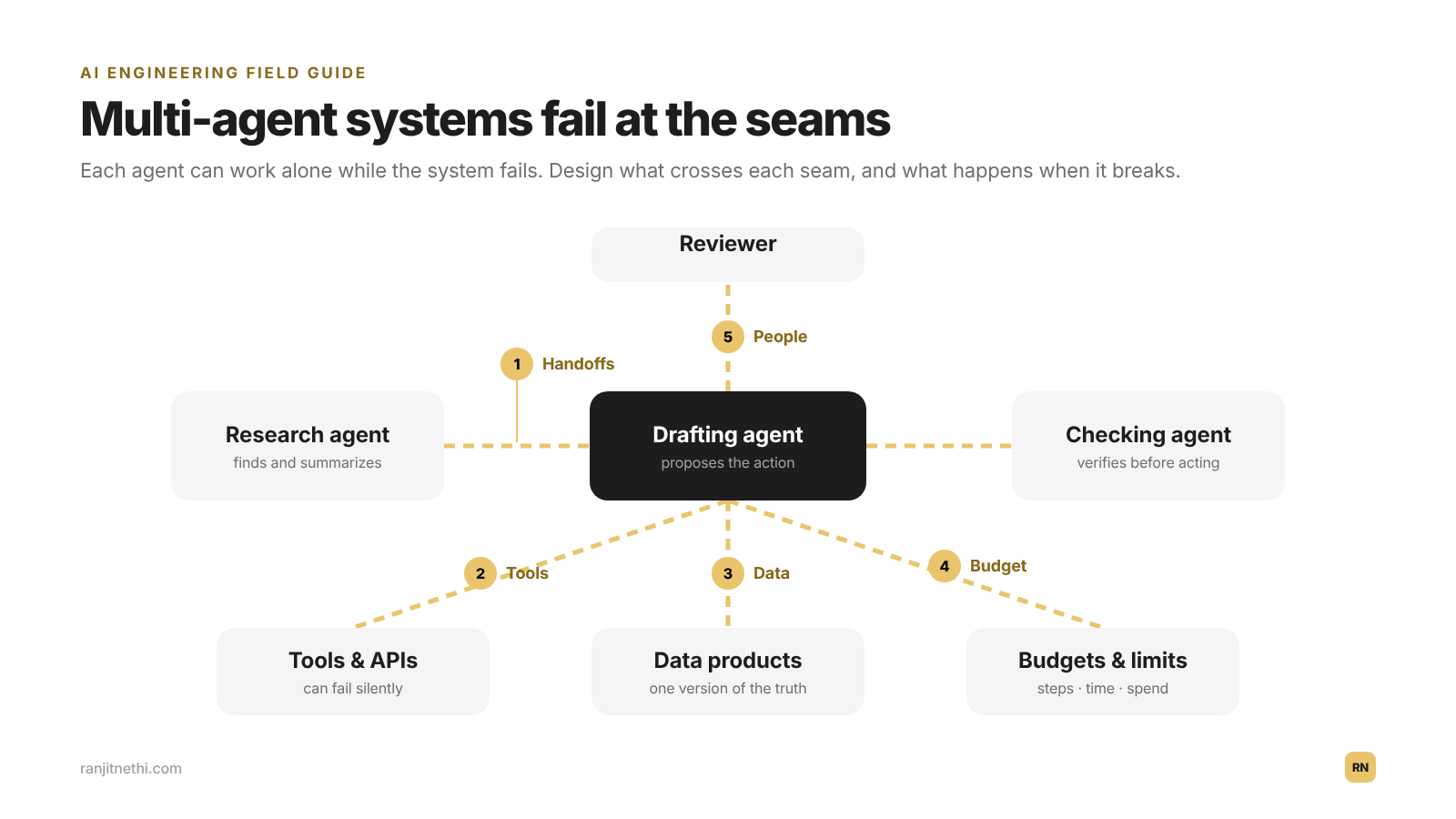
Each agent can work well on its own while the system fails. The risk is at the seams, meaning the places where one agent hands work to another, to a tool, to a data source, to a budget or to a person.
Seam 1: handoffs between agents
When one agent passes work to another, context is compressed. Assumptions made early are not passed on. Errors are not flagged; they are inherited. In a five-step chain, a small error rate at each step compounds into a large one at the end.
Each time work passes from one agent to the next, some detail is lost and mistakes are carried forward. Small errors add up.
Two failure patterns recur. Agents with overlapping roles duplicate work or contradict each other. Agents that communicate too freely flood each other with messages, slowing the system and burying the signal.
Controls: give every agent a narrow, written role and a clear definition of done. Pass work between agents in a structured format with explicit fields for assumptions and confidence, not free-form conversation. Decide in advance which agent has final say when two disagree.
Seam 2: tools and external systems
Agents depend on APIs, databases and enterprise applications that were not built for them. Response times vary. Some services fail silently, returning an empty result instead of an error. An agent that receives nothing often concludes that nothing exists, and proceeds confidently on a false premise.
When a system returns nothing, the agent may assume there is nothing to find, when in fact the system failed.
Controls: wrap every tool with timeouts, retries and explicit error states the agent can read. Track the success rate of each tool. Teach agents to treat a missing result as unknown, not as absent, and to escalate rather than guess.
Seam 3: data and context
Each agent sees a slice of the world through its context window and retrieval. Two agents can work from different versions of the same document or different definitions of the same metric, and reach incompatible conclusions without either being wrong on its own terms.
Two agents using different versions of a document or different definitions will disagree. Give them the same trusted data.
Controls: ground every agent in the same governed data products and the same definitions. Record which sources each agent used in the trace, so conflicts can be found and explained.
Seam 4: budgets and loops
Costs in multi-agent systems do not grow in a straight line. Agents call models, models call tools, and a disagreement between two agents can turn into a loop that runs until something stops it. A design that costs cents per task in testing can cost dollars per task in production.
Agents can get stuck in a loop and keep spending. Set hard limits on steps, time and money.
Controls: set step limits, time limits and spend limits per task, enforced by the orchestrator rather than requested in a prompt. Alert on tasks that exceed normal step counts. Use simpler workflows or single model calls for routine sub-tasks, and save agents for the steps that truly need planning.
Seam 5: people
Every multi-agent system eventually meets a person: the reviewer who approves an action, the user who receives the result, the operator who handles an exception. Too little autonomy, and people become a bottleneck approving trivial steps. Too much, and the system takes actions nobody would have approved.
Controls: route only uncertain or high-impact decisions to people, with the evidence they need to decide quickly. Start with low-risk actions fully automated and expand autonomy to higher-risk actions only as the evaluation data supports it.
Test the whole system
Agents that pass individual tests can still fail together. So evaluate end to end: the final outcome, the path taken, the number of steps, the cost and how the system behaved when a tool failed or data was missing. Deliberately inject failures in testing. A system that has never seen a tool time out will not handle one gracefully in production.
Public benchmarks are a starting point at best. The only benchmark that matters is your workflow, with your data, under realistic conditions.
My recommendation
Most enterprise problems do not need multiple agents. A single well-designed workflow with one agent at the point of genuine uncertainty is easier to build, test, run and explain. The real bottleneck in most enterprises is not model capability. It is messy data and fragmented processes, and adding agents does not fix either.
The rule
Design the seams first. If you cannot say what crosses each one and what happens when it fails, you are not ready for more than one agent.
Where is the weakest seam in your most ambitious agent design?
The terms, in plain language
| Term | What it means |
|---|---|
| Agent | An AI system that chooses its own steps to reach a goal |
| Multi-agent system | Several agents with different roles working on one job |
| Handoff | The point where work passes from one agent, tool or person to another |
| Orchestrator | The part of the system that directs the agents and enforces limits |
| Context window | The information an agent can see when it works |
| Timeout | A limit on how long the system waits for a reply |
Section 6.7 of the AI Engineering Guide · Last reviewed November 2026