The short version
- Fine-tuning means retraining a model on your own examples. It changes how a model behaves. It is a poor way to teach it facts.
- Try the simpler steps first: clear instructions, giving the model your documents, and giving it tools.
- Fine-tune only when testing shows the simpler steps are not enough.
The problem
“Should we fine-tune our own model?” is one of the first questions leadership teams ask about generative AI. It sounds like the serious, strategic option. In most cases it is the wrong first move.
Fine-tuning changes how a model behaves. It does not reliably teach a model facts, and it does not keep those facts current. Most enterprise problems are knowledge problems or process problems, and they are solved lower on what I call the customization ladder.
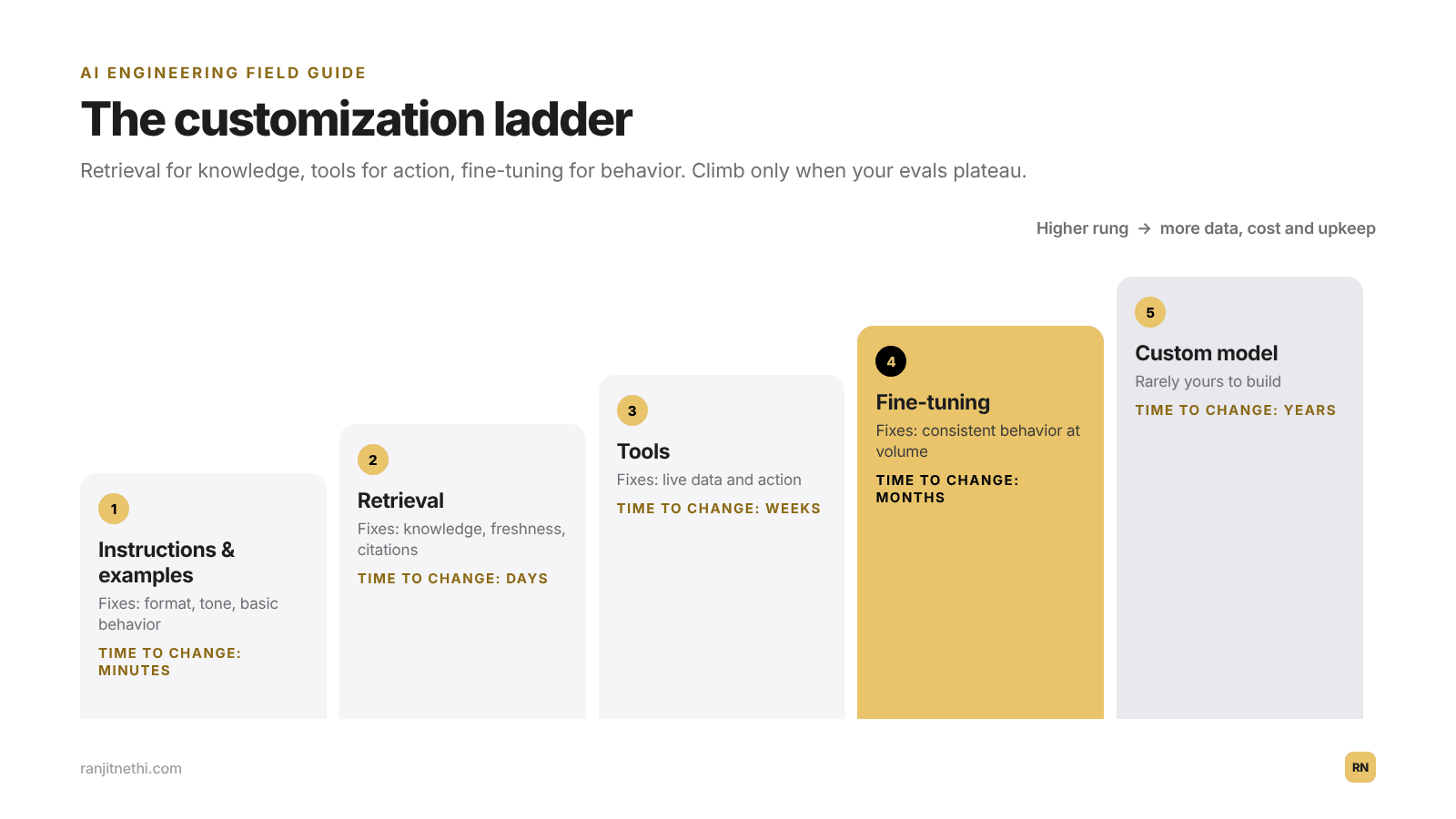
The five levels
1. Instructions and examples. Clear system instructions, a defined output format and a handful of good examples. This solves more problems than most teams expect, costs almost nothing and changes in minutes.
Tell the model clearly what you want and show it a few good examples.
2. Retrieval. When the model needs your knowledge, such as policies, product data, specifications or case history, give it that knowledge at the moment of need. Retrieval keeps information current, respects access rights and lets the system cite its sources.
Hand the model the right documents when it needs them, so its answers use your current information.
3. Tools. When the model needs live data or must act, such as checking inventory, pricing a configuration or creating a record, give it governed tools. Tools put exact answers where approximate ones are unacceptable.
Let the model look up live data or take an action through an approved system.
4. Fine-tuning. When the model must behave differently in a way instructions cannot achieve consistently, adjust the model itself with examples of the behavior you want.
Retrain the model on many examples so it behaves in a specific way every time.
5. Custom models. Training or substantially pre-training a model of your own. For almost every enterprise outside the technology sector, this belongs to model providers, not to you.
When fine-tuning is worth it
Fine-tuning earns its place in a few specific situations.
- Consistent format or style at volume. When thousands of outputs a day must follow a precise structure or voice and instructions still produce drift.
- Narrow, repetitive judgment. Classifying, routing or extracting from a specific document type, where a smaller tuned model can match a large general one.
- Cost and latency. Distilling the behavior of a large model into a smaller one, so high-volume tasks run faster and cheaper.
- Specialized language. Domains with dense jargon or notation that general models handle poorly, even with good context.
Notice what is absent from that list: “so the model knows our products.” Knowledge belongs in retrieval, where it can be updated tomorrow without retraining anything.
If the model needs to know your products, give it your product documents. Do not retrain it.
The hidden costs
The training run is the cheap part. The real costs are around it.
You need a curated, labeled dataset, often hundreds to thousands of high-quality examples reviewed by people who know the domain. You need an evaluation set to prove the tuned model beats the alternatives. You need a plan to repeat the process when the base model is upgraded, because a tuned model is tied to the version it was built on. And you need governance for the training data itself: permission to use it, protection of sensitive content and assurance it has not been contaminated.
When teams add those costs to the business case, retrieval and better instructions usually win.
The order to follow
The approach I recommend is the same for nearly every use case. Start at the bottom of the ladder. Build the evaluation set first. Climb one rung at a time, and only when the evaluation shows the current rung has plateaued below the bar the business needs.
If fine-tuning is still justified after that, it will be justified with evidence, and the evaluation set you built along the way will tell you whether it worked.
The rule
Retrieval for knowledge, tools for action, fine-tuning for behavior. Never fine-tune to fix a knowledge problem.
What problem are your teams trying to solve with fine-tuning that retrieval would solve sooner?
The terms, in plain language
| Term | What it means |
|---|---|
| Fine-tuning | Retraining an existing model on your own examples to change its behavior |
| Retrieval | Finding the right documents and giving them to the model |
| Tool | A system the model may call, such as an inventory check |
| Distillation | Teaching a small, cheap model to copy a large one |
| Base model | The original model before any retraining |
| Evaluation set | A fixed list of test cases used to compare options |