The short version
- A prompt is the set of instructions you give an AI model. Changing one line can change every answer.
- Treat prompts like software: save each version, test each change against a fixed set of examples, and have a second person review it.
- A new model version is also a change. Test it the same way before you switch.
The problem
In a production AI system, the prompt is part of the program. Change one sentence in a system instruction and you can change tone, format, refusal behavior and accuracy across every interaction. Yet in many organizations, prompts are still edited in a text box by whoever has access, with no record of what changed or why.
That would be unacceptable for application code. It should be unacceptable for prompts.
What needs to be managed
The definition of configuration has widened. A production AI system’s behavior depends on a bundle of artifacts that must move together:
- The system instructions and prompt templates
- The model name and version
- Generation settings such as temperature and output limits
- The tool definitions the model may call
- The retrieval settings, from filters to the number of chunks returned
- The output schema the application expects
Change any one of these and you have changed the product. So they are versioned together, released together and rolled back together.
Many settings shape how the AI behaves, not only the prompt. Save them as one package, so you can go back to the last good package if something breaks.
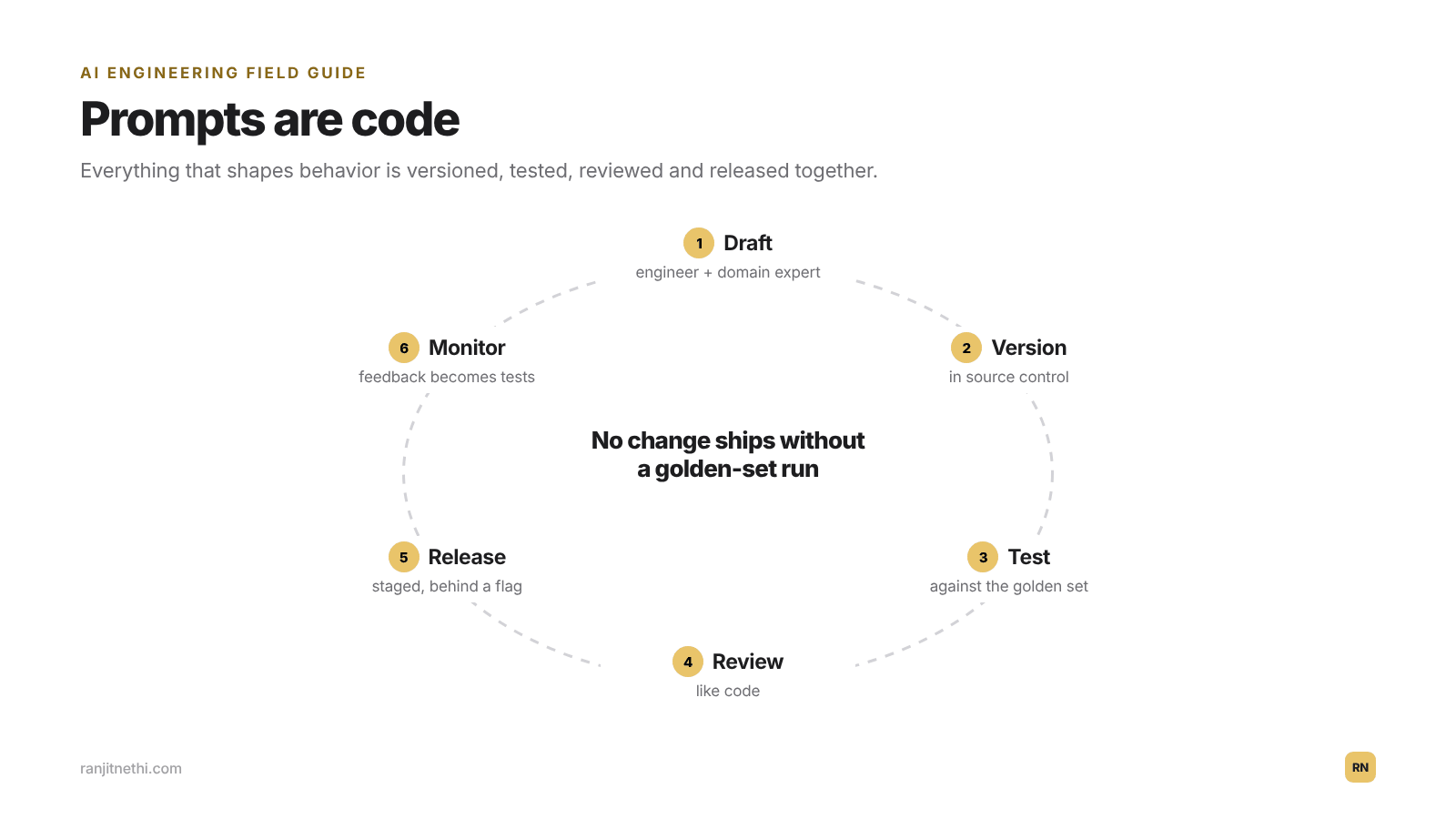
The six steps I use
Draft with the domain expert. The best prompts are written by an engineer and a business expert side by side. The engineer knows the model’s habits. The expert knows what a good answer looks like and which mistakes are unacceptable.
Version in source control. Prompts live in the repository next to the code that uses them, as parameterized templates. Every change has an author, a reason and a reviewer.
Test against a golden set. Before any change ships, it runs against a fixed set of real inputs with expected outputs or grading criteria. The question is not “does the new prompt look better on three examples?” It is “did anything that used to work stop working?”
Keep a fixed list of real examples with known good answers. Run every change against it and check that nothing that used to work is now broken.
Review like code. A second person reads the change and the evaluation results. Prompt reviews catch more than you would expect: ambiguous instructions, conflicting rules, examples that leak sensitive data.
Release behind a flag. New prompts go to a fraction of traffic or run in shadow mode first, with results compared against the current version.
Try the change on a small share of users first, and compare it with the current version.
Monitor and loop back. Production feedback, both explicit ratings and observed corrections, feeds new cases into the golden set. The test suite grows from real failures.
Treat a new model as a change
The same discipline applies when a model provider ships a new version. Teams often swap models because the new one scores better on public benchmarks, then discover that formatting changed, refusals increased or a specific extraction got worse.
A model upgrade is a release. It runs through the same golden set, the same review and the same staged rollout as any other change. Public benchmarks tell you about the model. Your evaluation set tells you about your product.
A new model can be better in general and worse for your task. Test it on your own examples.
Build a shared prompt library
Across a portfolio, the same patterns repeat: summarizing a case, extracting fields from a document, classifying a request, drafting a customer reply. Each team should not invent its own version.
A shared library of reviewed templates, each with its evaluation set and known limitations, saves time and raises the floor of quality across every team. It also gives governance one place to look when a policy changes.
Why leaders should care
This sounds like engineering hygiene, and it is. It is also an audit question. When a customer, regulator or internal reviewer asks why the system said what it said on a particular day, someone must be able to reconstruct the exact instructions, model and context in force at that moment.
If your teams cannot do that, they are running a production system they cannot explain.
The rule
No prompt change without a test run. If the golden set did not run, the change did not ship.
Could your team tell you which prompt version produced a specific answer last Tuesday?
The terms, in plain language
| Term | What it means |
|---|---|
| Prompt | The instructions given to an AI model |
| System instructions | The standing instructions that apply to every request |
| Version control | A system that saves every change, who made it and why |
| Golden set | A fixed list of test examples with known good answers |
| Temperature | A setting that controls how varied the model’s answers are |
| Rollback | Going back to the previous version |