The short version
- AI systems are software. They need the same testing, release and security discipline.
- They also need four extra things: ongoing quality tests, care for the knowledge they use, cost tracking and a way to use people’s corrections.
- Ask your team for three items: a record of every change, a one-page scorecard and a practiced way to undo a change.
The problem
There is a temptation to treat generative AI as a different kind of technology that needs a different kind of team and a different set of rules. Some of that is true. Most of it is not.
Generative AI systems are software. They need version control, automated testing, continuous delivery, infrastructure as code, logging, security review and incident response, all of it. What changes is that they add non-determinism, new artifacts to manage and new ways to fail. The discipline that handles this is often called GenAIOps or LLMOps. I think of it more simply: ship AI like software, and run it like a product.
GenAIOps and LLMOps are names for the routine of releasing and running AI systems safely. The idea is simple: test every change, release it in steps and keep watching it.
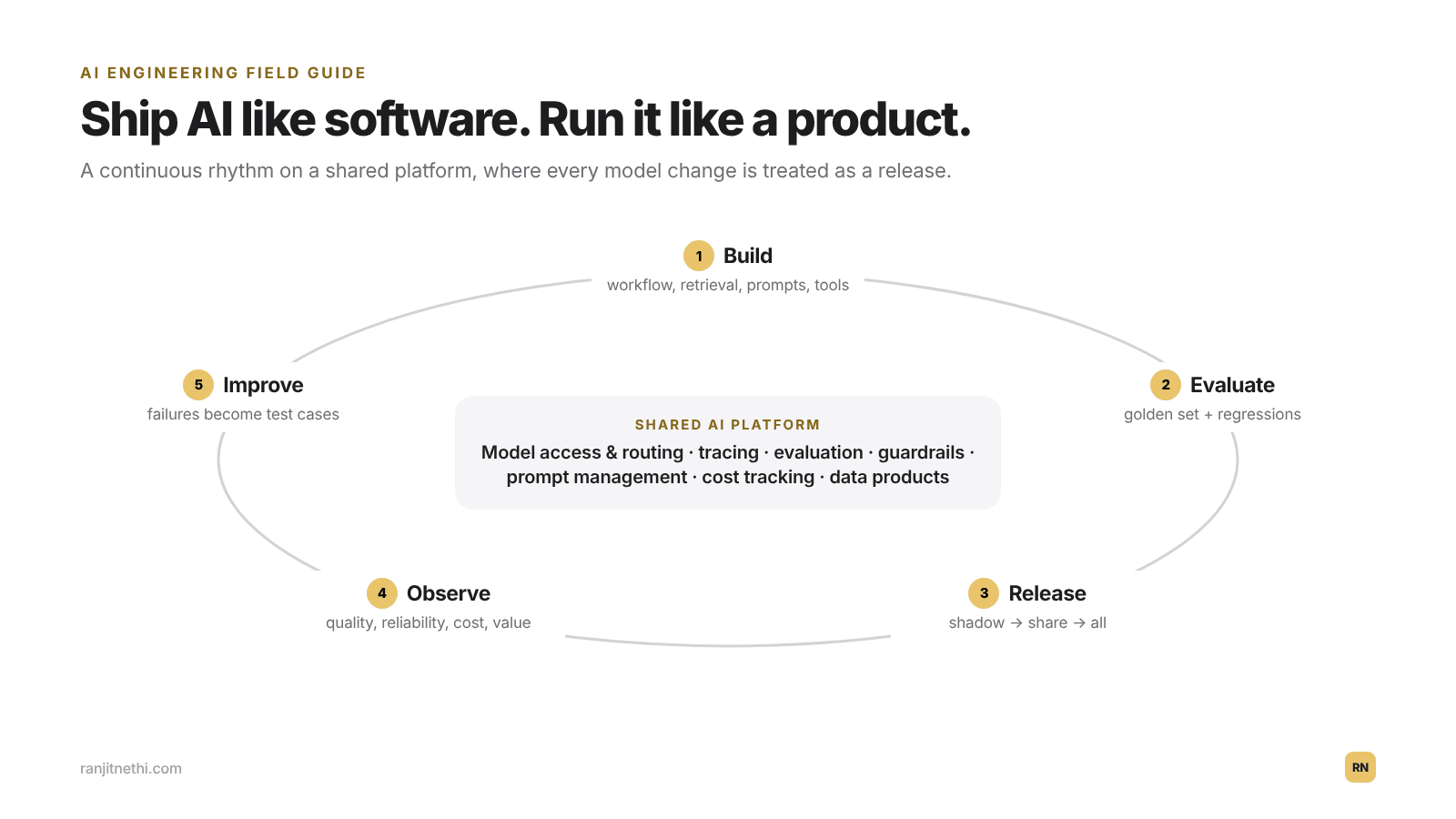
The routine
Build. Engineers and domain experts design the workflow, the retrieval, the prompts and the tools together. Everything that shapes behavior lives in source control, including prompts, model settings, tool definitions and retrieval configuration.
Evaluate. Every change runs against the evaluation suite before it ships: golden examples, adversarial cases and the regression tests built from past failures. Results are compared against the current production version, not judged in isolation.
Release. Changes go out in stages: shadow mode, a small share of traffic, then everyone. Each stage has criteria for promotion and a one-step rollback. Model upgrades from providers follow the same path, because a new model version is a release.
Do not switch everyone to a new version at once. Try it quietly, then with a few users, then with all. Be able to go back in one step.
Observe. Traces, quality scores, reliability, cost per resolved task and the business metric are watched continuously, with alerts for drift and budget overruns.
Improve. Production failures become test cases. User corrections become training examples or prompt fixes. The next cycle starts from evidence.
Four extra practices for AI
Evaluation as a first-class asset. In conventional software, tests check deterministic behavior. In AI systems, evaluation sets measure quality on a distribution of real inputs, graded by people and by automated judges. Building and maintaining them is ongoing engineering work, and it deserves dedicated ownership.
Normal software tests check for one right answer. AI tests check quality across many real examples. Someone must own and maintain those tests.
Context management. The knowledge a system retrieves is part of its behavior. Index freshness, document versions and access rules need the same care as code and data pipelines.
Usage economics. Every request has a variable cost. Spend tracking, budgets per use case, caching, model routing and cost per resolved task belong in the platform from day one, not after the first surprise invoice.
Human feedback loops. Reviewers, users and domain experts are part of the system. Their corrections must flow back into evaluation sets and improvements through a designed process, not through scattered messages to the engineering team.
Build a shared platform
If each team builds these capabilities alone, the organization ends up with a dozen evaluation frameworks, a dozen ways to log traces and a dozen sets of guardrails, none of them maintained well.
The answer is a shared AI platform that provides the common layers: model access and routing, tracing and evaluation tooling, guardrail services, prompt and configuration management, cost tracking and governed data products for retrieval. Product teams then build use cases on top, focusing on the business problem rather than the plumbing. This is the same platform logic that makes forward-deployed teams viable at scale.
Build the common tools once, on a shared platform, so each team does not rebuild them.
What leaders should ask for
Three things tell you whether an AI program is being run as a product or as a series of experiments.
- A release record. For any production AI system, the team can show what changed, when, who approved it and what the evaluation showed.
- A one-page scorecard. Quality, reliability, cost per resolved task and the business metric, updated at least monthly.
- A rollback drill. The team has practiced reverting a prompt, a model version or a tool, and knows how long it takes.
If those three exist, the operating model is working. If they do not, the program is accumulating risk that no demo will reveal.
The rule
A model change is a release. Evaluate it, stage it and be ready to roll it back.
When did your team last practice rolling back an AI change?
The terms, in plain language
| Term | What it means |
|---|---|
| GenAIOps / LLMOps | The practice of releasing and running AI systems reliably |
| Version control | A system that saves every change, who made it and why |
| Shadow mode | The new version runs in the background and is compared, but users do not see it |
| Rollback | Going back to the previous version |
| Evaluation suite | The full set of tests used to check quality |
| Drift | A slow change in inputs or quality over time |